
RE
My name is Mrs Christy, and I am the Religious Education (RE) lead at Stanway Primary School. I have always been curious about different religions and world views and since being a student I have enjoyed exploring how and why people follow their faith and beliefs. As a teacher, I am passionate about fostering a thoughtful, inclusive and engaging approach to the enquiry of religions and world-views across our school.
At Stanway Primary, we follow the Essex Agreed Syllabus for Religious Education 2022 and use the Saffron Academy Trust Scheme of work. This scheme reflects an enquiry-led, multifaith syllabus, considered and explored through three distinct lenses; Theology, Philosophy, and Human and Social sciences. In each year group, children will endeavour to answer each unit of enquiry by thinking through believing (Theology), thinking through thinking (Philosophy) and thinking through living (Human and Social Science). The enquiry units are detailed below.
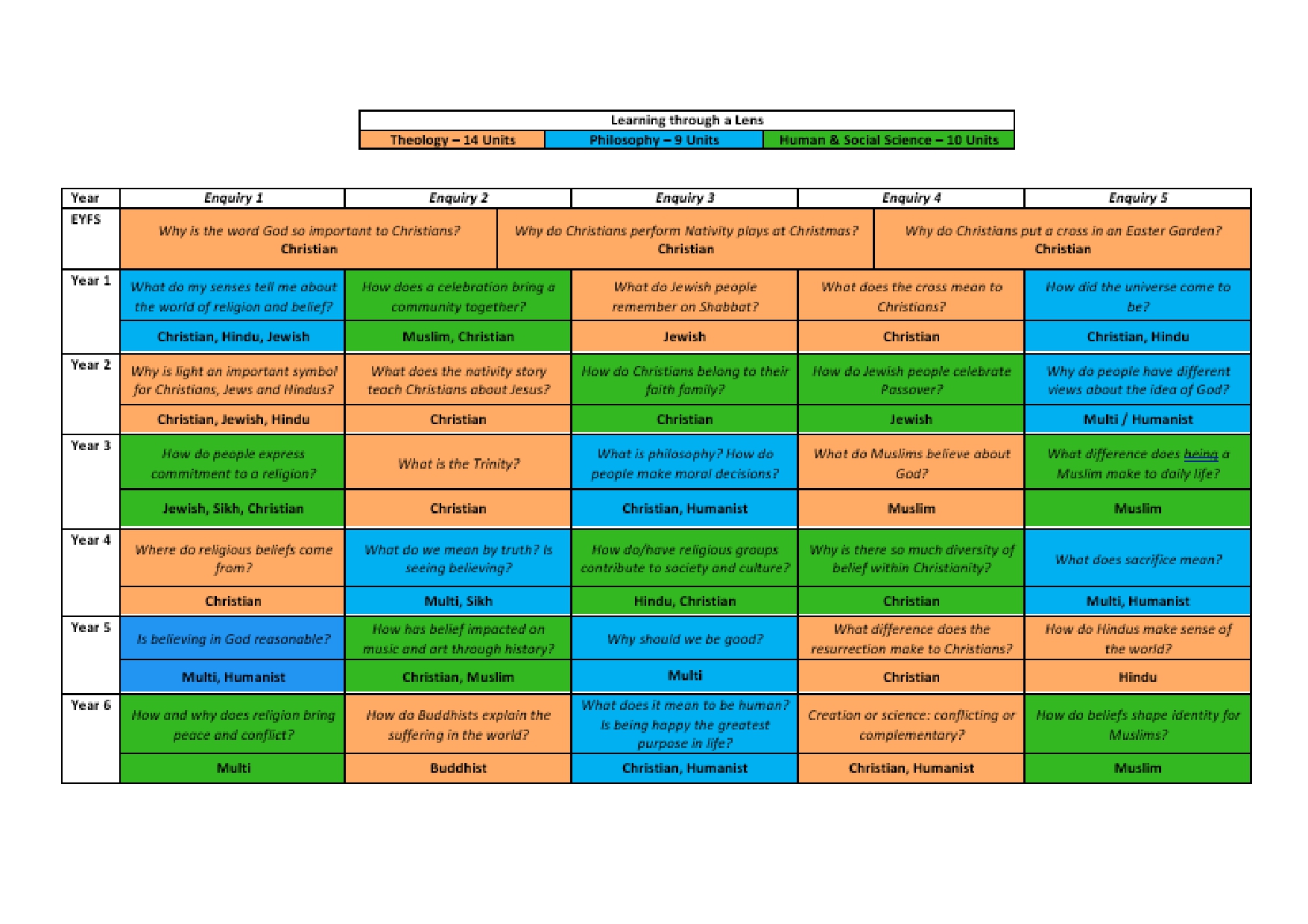
It is my role as RE lead to support staff in developing pupils' religious literacy. I value the opportunity to make RE a subject that allows children to be curious, to ask questions, think deeply and reflect on their own perspectives in an ever-changing world.
At our school, pupils explore religious viewpoints and belief systems across the school right from Reception through to Year Six. We foster a hands-on approach using religious artefacts, stories, music, art and practical activities. We are lucky to have forged strong links with our local churches and take opportunities to visit and invite speakers from our community to explain about key parts of their faith and belief systems. KS1 and Early Years enjoy regular drama – based assemblies led by Open the Book Group, where Bible stories are explored in a fun and age-appropriate way. In all year groups, children will hear about key religious events and significant leaders through carefully planned assemblies. This year a Mantle of the Expert project in November will allow pupils to explore different religions through the theme `Lighting the way for a shared future` during Interfaith Week 2026.
Religious Education at Stanway Primary encourages pupils to be curious and open-minded, helping them to explore and discuss big questions about life, belief and identity with respect, empathy and tolerance.
Purpose of study
An engaging, broad and balanced Religious Education curriculum is delivered in accordance to the Agreed Syllabus for Essex (exploRE- 2015). We reflect the fact that religious traditions in Great Britain are in the main Christian, while taking into account the teachings and practices of other principal religions represented in Great Britain, Judaism, Hinduism, Islam, Sikhism, and Buddhism. Through high-quality lessons children are introduced to learning about and learning from religions and beliefs. RE also plays a central role in developing spiritual, moral, social and cultural development, where all pupils feel valued citizens.
Aims
The aim of The Essex Agreed Syllabus for Religious Education is to:
• provoke challenging questions about the meaning and purpose of life, beliefs, the self, issues of right and wrong, and what it means to be human. It develops pupils’ knowledge and understanding of Christianity, other principal religions, and religious traditions that examine these questions, fostering personal reflection and spiritual development.
• encourage pupils to explore their own beliefs (whether they are religious or nonreligious), in the light of what they learn, as they examine issues of religious belief and faith and how these impact on personal, institutional and social ethics, and to express their responses. This also builds resilience to anti-democratic or extremist narratives.
• enable pupils to build their sense of identity and belonging, which helps them flourish within their communities and as citizens in a diverse society.
• teach pupils to develop respect for others, including people with different faiths and beliefs, and helps to challenge prejudice.
• prompt pupils to consider their responsibilities to themselves and to others, and to explore how they might contribute to their communities and to wider society. It encourages empathy, generosity and compassion.
We use the Scheme of Work provided by the Saffron Hub.
RE in EYFS
Religious Education in Reception is reflected and explored through 2 areas of learning within the Early Years Foundation Stage Framework. These areas are, Personal, Social and Emotional Development and Understanding of the World. Through these areas, children can reflect on themselves and others as well as develop an understanding through stories, first-hand experiences and opportunities for play.
Programme of Study for Key Stage One
When covering each study unit, the main emphasis will be on Christianity. Material related to other major world faiths will also be incorporated, along with secular viewpoints where appropriate.
The following six study units are to be explored at Key Stage One, the equivalent of one study unit per term:
• Special people
• Special places
• Special words and stories
• Special things in nature
• Special symbols and objects
• Special ways of living
Programme of Study for Key Stage Two
At Key Stage Two, pupils learn about Christianity, other principal religions (Hinduism, Judaism, Buddhism, Islam, Sikhism) and Humanism, recognising the impact of religion and belief on individuals and society locally, nationally and globally. They also develop awareness of the fact that many people’s beliefs change in the light of their life experiences. This is done in a spirit of respect and open-mindedness, so that barriers, misunderstandings and prejudices are broken down while critical awareness is retained.
The programme of study covers these areas for each religion and for Humanism (where appropriate)
• Places of worship
• Sacred writings
• Founders/people who established different religions
• Life-changing experiences
• Beliefs/ teachings
• Initiation ceremonies
• Death and afterlife
• Creation stories
• Worship and devotional practices
Parents have the right to withdraw their children from religious education and/or collective worship.